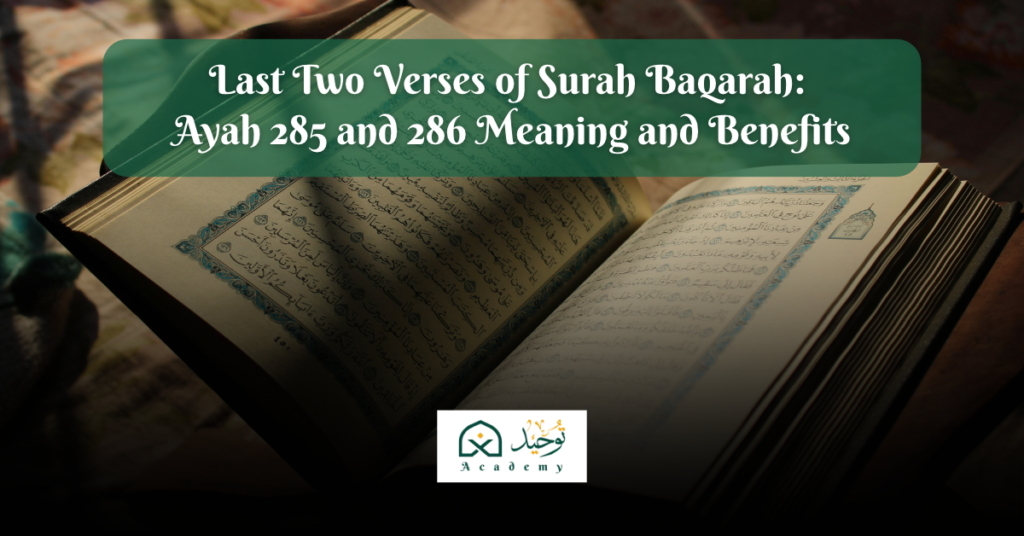
Many people search for the “last two surahs of Surah Baqarah,” but they mean the last two verses of Surah Al-Baqarah. The last two verses of Surah Baqarah are Ayah 285 and Ayah 286. They close the longest surah of the Quran. The Prophet ﷺ said that whoever recites them at night, they will be enough for him.
Here is the text, meaning, authentic hadith and a 7-day memorisation plan.
Last Two Surahs or Last Two Verses of Al Baqarah?
They are verses, not surahs. A surah is a full chapter. An ayah is one verse inside it. Surah Al-Baqarah is one surah, so its “last two” are ayah 285 and ayah 286.
- The last two surahs of the whole Quran are Surah Al-Falaq and Surah An-Nas, the final two of the 114 surahs of the Quran.
- The last two verses of Al Baqarah are called “Amanar Rasul” after their first words, or “Khawatim al-Baqarah,” meaning the closing verses of Al-Baqarah.
How Many Ayats Are in Surah Baqarah?
Surah Al-Baqarah has 286 ayahs, more than any other surah. It was revealed in Madinah and runs from Juz 1 into Juz 3, where its last two ayahs sit. To compare it with the rest of the Quran, see how many ayahs are in the Quran.
Last Two Verses of Surah Baqarah in Arabic, Transliteration and English
Ayah 285
ءَامَنَ ٱلرَّسُولُ بِمَآ أُنزِلَ إِلَيْهِ مِن رَّبِّهِۦ وَٱلْمُؤْمِنُونَ ۚ كُلٌّ ءَامَنَ بِٱللَّهِ وَمَلَـٰٓئِكَتِهِۦ وَكُتُبِهِۦ وَرُسُلِهِۦ لَا نُفَرِّقُ بَيْنَ أَحَدٍ مِّن رُّسُلِهِۦ ۚ وَقَالُوا۟ سَمِعْنَا وَأَطَعْنَا ۖ غُفْرَانَكَ رَبَّنَا وَإِلَيْكَ ٱلْمَصِيرُ ٢٨٥
Transliteration: Aamanar Rasoolu bimaa unzila ilaihi mir Rabbihee wal mu’minoon. Kullun aamana billaahi wa malaa’ikatihee wa kutubihee wa rusulih. Laa nufarriqu baina ahadim mir rusulih. Wa qaaloo sami’naa wa ata’naa, ghufraanaka Rabbanaa wa ilaikal maseer.
Meaning: The Messenger ˹firmly˺ believes in what has been revealed to him from his Lord, and so do the believers. They ˹all˺ believe in Allah, His angels, His Books, and His messengers. ˹They proclaim,˺ “We make no distinction between any of His messengers.” And they say, “We hear and obey. ˹We seek˺ Your forgiveness, our Lord! And to You ˹alone˺ is the final return.”
Ayah 286: The Last Ayat of Surah Al Baqarah
لَا يُكَلِّفُ ٱللَّهُ نَفْسًا إِلَّا وُسْعَهَا ۚ لَهَا مَا كَسَبَتْ وَعَلَيْهَا مَا ٱكْتَسَبَتْ ۗ رَبَّنَا لَا تُؤَاخِذْنَآ إِن نَّسِينَآ أَوْ أَخْطَأْنَا ۚ رَبَّنَا وَلَا تَحْمِلْ عَلَيْنَآ إِصْرًا كَمَا حَمَلْتَهُۥ عَلَى ٱلَّذِينَ مِن قَبْلِنَا ۚ رَبَّنَا وَلَا تُحَمِّلْنَا مَا لَا طَاقَةَ لَنَا بِهِۦ ۖ وَٱعْفُ عَنَّا وَٱغْفِرْ لَنَا وَٱرْحَمْنَآ ۚ أَنتَ مَوْلَىٰنَا فَٱنصُرْنَا عَلَى ٱلْقَوْمِ ٱلْكَـٰفِرِينَ ٢٨٦
Transliteration: Laa yukalliful laahu nafsan illaa wus’ahaa. Lahaa maa kasabat wa ‘alaihaa mak tasabat. Rabbanaa laa tu’aakhiznaa in naseenaa aw akhta’naa. Rabbanaa wa laa tahmil ‘alainaa isran kamaa hamaltahoo ‘alal lazeena min qablinaa. Rabbanaa wa laa tuhammilnaa maa laa taaqata lanaa bih. Wa’fu ‘annaa, waghfir lanaa, warhamnaa. Anta mawlaanaa fansurnaa ‘alal qawmil kaafireen.
Meaning: Allah does not require of any soul more than what it can afford. All good will be for its own benefit, and all evil will be to its own loss. ˹The believers pray,˺ “Our Lord! Do not punish us if we forget or make a mistake. Our Lord! Do not place a burden on us like the one you placed on those before us. Our Lord! Do not burden us with what we cannot bear. Pardon us, forgive us, and have mercy on us. You are our ˹only˺ Guardian. So grant us victory over the disbelieving people.”
The Story Behind the Last Verses of Surah Baqarah
These verses came as relief after the companions were worried by ayah 284. That ayah says Allah will hold people to account for what they show and what they hide inside. The companions felt they could not control every passing thought and came to the Prophet ﷺ upset. He told them to say, “We hear and we obey.” Then Allah revealed ayah 285 praising their faith, and ayah 286 easing their worry (Sahih Muslim 125 and 126).
In the report of Ibn Abbas, after each request in the dua of ayah 286, Allah said, “I have done so” (Sahih Muslim 126). So every line of this dua was accepted.
What the Last Two Ayat of Surah Baqarah Teach Us
- Core belief: faith in Allah, His angels, His books and His messengers, and the return to Him.
- Respect for every prophet: believers do not accept some and reject others.
- “We hear and we obey”: the right answer to Allah’s commands.
- No load beyond your strength: every duty Allah gives you is within your reach.
- Forgetting is not defiance: we ask Allah not to blame us for honest slips.
- How to ask: the dua moves from pardon, to forgiveness, to mercy, to help.
Study them word by word in our online Quran with Tafseer classes.
Authentic Hadith About the Last 2 Verses of Al Baqarah
They Are Enough for You at Night
Abu Mas’ud al-Ansari reported that the Prophet ﷺ said: “Whoever recites the last two verses of Surah Al-Baqarah at night, they will be enough for him” (Sahih al-Bukhari 5009, Sahih Muslim 807). Imam an-Nawawi noted that scholars read “enough” as covering night prayer, or as protection from Shaytan and harm, and both can be true.
A Light Given to No Prophet Before
Ibn Abbas reported that an angel told the Prophet ﷺ to rejoice in two lights given to no prophet before him: Al-Fatihah and the last verses of Surah Al-Baqarah. He would be given what he asks for in every letter he reads from them (Sahih Muslim 806).
A Gift From the Treasure Beneath the Throne
Hudhayfah reported that the Prophet ﷺ was given these verses from a treasure beneath the Throne, which no prophet before him received (Musnad Ahmad 23251, authentic chain).
Given on the Night of Mi’raj
On the Night Journey, the Prophet ﷺ was given three things: the five daily prayers, the closing verses of Surah Al-Baqarah, and forgiveness of major sins for those of his Ummah who do not worship anything besides Allah (Sahih Muslim 173).
Shaytan Stays Away From the Home
The Prophet ﷺ said Allah wrote a book two thousand years before creating the heavens and the earth, and sent down from it the two verses that end Al-Baqarah. If they are recited in a house for three nights, Shaytan will not come near it (Jami at-Tirmidhi 2882, graded hasan by at-Tirmidhi and sahih by Ibn Hibban and al-Hakim).
When and How to Recite the Last Two Ayat of Surah Baqarah
- Timing: Night runs from Maghrib to Fajr. Most people read them before sleep.
- In prayer: Recite them after Al-Fatihah in Isha, Tahajjud or Witr, before Dua Qunoot.
- With Tajweed: Stretch the long vowels and give a light qalqalah bounce on the ط in “akhta’naa.” A Quran with Tajweed teacher can check this quickly.
- From a mushaf or app: Reading from a copy still earns the reward.
How to Memorize the Last Two Verses of Surah Baqarah in 7 Days
- Day 1: Listen to a trusted reciter five times while following the text.
- Day 2: Ayah 285 up to “wa rusulih.”
- Day 3: The rest of ayah 285.
- Day 4: Ayah 286 up to “aw akhta’naa.”
- Day 5: Up to “maa laa taaqata lanaa bih.”
- Day 6: The end of ayah 286.
- Day 7: Recite both to a family member or teacher, then read them every night.
Our online Quran classes for kids often use these verses as an early goal, and our Quran memorization course builds on the same small daily steps.
FAQs About the Last Two Verses of Surah Baqarah
What are the last two verses of Surah Baqarah called?
They are called “Amanar Rasul” after their first words, and “Khawatim al-Baqarah,” meaning the closing verses of Al-Baqarah.
Which is the last verse of Surah Baqarah?
It is ayah 286. It begins with “Laa yukalliful laahu nafsan illaa wus’ahaa” and ends with “fansurnaa ‘alal qawmil kaafireen.”
Can I recite the last two ayat of Surah Baqarah in the morning?
Yes, the Quran is rewarded at any time, but the promise that “they will be enough for him” is tied to the night.
Do I need to understand Arabic to get the reward?
No. You are rewarded for the recitation itself. Learning the meaning helps you make the dua with more focus.
Should I read Ayatul Kursi or the last two verses before bed?
Read both. Ayatul Kursi before sleep comes from a separate authentic hadith in Sahih al-Bukhari.
Summary
The “last two surahs of Surah Baqarah” are actually two verses, ayah 285 and ayah 286, which close the 286 ayahs of Al-Baqarah. Authentic hadith in Bukhari, Muslim, Ahmad and Tirmidhi say they are enough for anyone who recites them at night, came from a treasure beneath the Throne, and keep Shaytan away from the home. Learn their meaning, recite them every night between Maghrib and Fajr, and memorize them in seven short daily steps.