Bismillah means “In the name of Allah.” The full phrase, Bismillahirrahmanirrahim, means “In the name of Allah, the Most Gracious, the Most Merciful.” Muslims say it before eating, reading the Quran, leaving the house, and starting almost any good task. It is also the opening line of 113 of the 114 Surahs of the Quran.
Most of us learned to say Bismillah as kids, long before we knew what it meant. This guide covers the Bismillah meaning word by word, Bismillah in Arabic, where it appears in the Quran, and when the Prophet ﷺ told us to say it, with a source for each point.
What Does Bismillah Mean?
Bismillah is a short Arabic phrase that means “In the name of Allah.” It is made of three parts: bi (in or with), ism (name), and Allah.
Arabic scholars explain that the phrase carries a hidden verb. When you say Bismillah before food, the full sense is “I eat in the name of Allah.” Before reading, it becomes “I read in the name of Allah.” The action changes, but the message stays the same. You start with Allah’s name and ask for His help in what you are about to do.
Bismillah vs Bismillahirrahmanirrahim
- Bismillah (short form): “In the name of Allah.” Said in daily life, like before eating, drinking, or getting into a car.
- Bismillahirrahmanirrahim (full form): “In the name of Allah, the Most Gracious, the Most Merciful.” Said before reciting a Surah and written at the top of letters and books.
The full form is also called the Basmala or Tasmiyah.
Bismillah in Arabic: How to Write and Say It
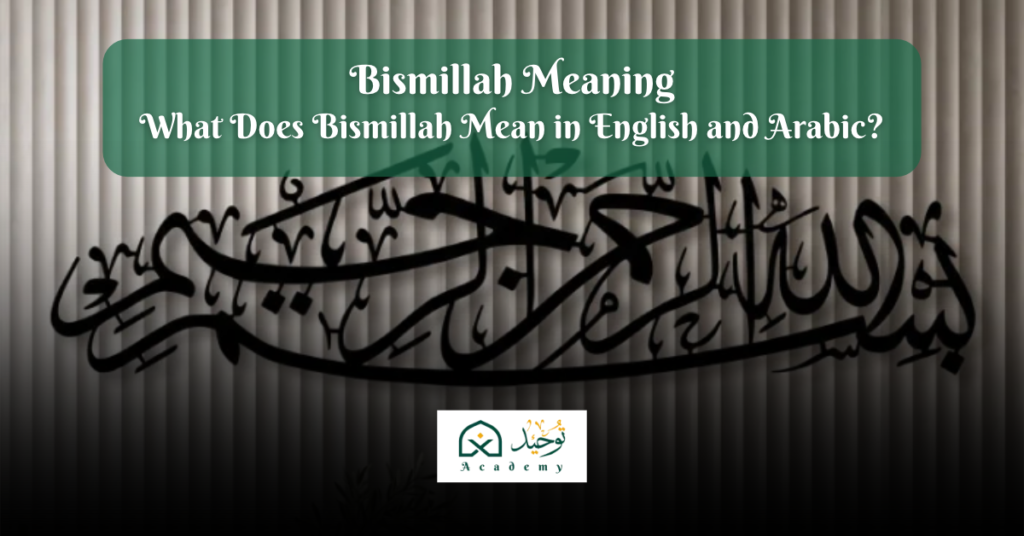
Bismillah in Arabic is written بِسْمِ اللهِ, and Bismillahirrahmanirrahim in Arabic is written بِسْمِ اللهِ الرَّحْمٰنِ الرَّحِيْمِ. You may also see it as one symbol, ﷽, a single calligraphy character used on phones and computers.
Here is a small detail most guides skip. The word ism (name) normally begins with an alif (اسم). In the Basmala, that alif is dropped in writing, so it is spelled بِسْمِ and not بِاسْمِ. This is the standard spelling in every printed Mushaf.
To say it correctly:
- Read it as Bismillaahir Rahmaanir Raheem, joining the words smoothly.
- Make the “Ra” in Rahmaan and Raheem a full, heavy sound.
- Say the “h” in Rahmaan from the throat. It is a soft ح sound, not the “Reh” sound many of us grew up with.
- Stretch the “aa” in Rahmaan and the “ee” in Raheem for two counts.
If these sounds feel new, a teacher can fix them in a few lessons. Our Quran with Tajweed course covers heavy letters and stretching rules step by step.
Bismillahirrahmanirrahim Meaning Word by Word
Here is the full Bismillahirrahmanirrahim meaning, one word at a time.
| Arabic | Transliteration | Meaning in English |
|---|---|---|
| بِ | Bi | In, with |
| اسْمِ | Ismi | The name of |
| اللهِ | Allah | Allah, the one true God |
| الرَّحْمٰنِ | Ar-Rahman | The Most Gracious |
| الرَّحِيْمِ | Ar-Rahim | The Most Merciful |
If you want to go deeper and understand Surah Al-Fatiha this way, our Tafseer classes start right here.
What Is the Difference Between Ar-Rahman and Ar-Rahim?
Both names come from the same Arabic root, r-h-m, which means mercy. Many scholars explain the difference like this:
- Ar-Rahman is the wide mercy Allah shows to all creation in this world, believers and non-believers alike. Food, air, and health come from it.
- Ar-Rahim is the special, lasting mercy Allah keeps for the believers, most of all in the Hereafter.
So the full phrase reminds you of both kinds of mercy before you begin.
What Does Bismillah Mean in English?
The most common Bismillah translation in English is “In the name of God,” but the closer Bismillah meaning in English is “In the name of Allah.”
Allah is the personal name of the One God. The English word “god” can be made plural or used for false gods. The word “Allah” has no plural and no gender. That is why many translators keep the word Allah when writing Bismillah in English.
Where Does Bismillah Appear in the Quran?
Bismillahirrahmanirrahim appears 114 times in the Quran. Here is how that count works:
- It opens 113 Surahs.
- It is missing at the start of Surah At-Tawbah (Surah 9), the only Surah without it.
- It appears inside Surah An-Naml (27:30), at the start of the letter Prophet Sulaiman (Solomon) sent to the Queen of Sheba.
So the total matches the number of Surahs in the Quran. Ibn Abbas reported that the Prophet ﷺ did not know where one Surah ended until Bismillahirrahmanirrahim was revealed (Sunan Abi Dawud 788). It works like a marker between Surahs.
Is Bismillah the First Verse of Surah Al-Fatiha?
Scholars differ on this. The Shafi’i school counts it as the first verse of Al-Fatiha, and most printed Mushafs follow this count. The Hanafi school sees it as a separate verse placed before Surahs, not part of Al-Fatiha. This is also why the total number of ayahs in the Quran changes depending on whether the Basmala is counted. Both views are respected, which is why some imams recite it aloud in prayer and others say it quietly.
When Should You Say Bismillah?
The Prophet ﷺ taught Muslims to say Bismillah before daily actions like eating, entering the home, and closing doors at night. Here are the times backed by authentic sources:
- Before eating: The Prophet ﷺ told young Umar ibn Abi Salamah to mention Allah’s name, eat with his right hand, and eat from what is near him (Sahih al-Bukhari 5376, Sahih Muslim 2022).
- If you forget before eating: Say Bismillahi awwalahu wa akhirahu, meaning “In the name of Allah at its beginning and its end” (Sunan Abi Dawud 3767, Jami at-Tirmidhi 1858).
- Entering the home: When a person mentions Allah on entering and at dinner, Shaytan tells his followers there is no place to stay and no dinner for them (Sahih Muslim 2018).
- At night: The Prophet ﷺ told us to close our doors and mention Allah’s name, because Shaytan does not open a closed door (Sahih al-Bukhari 3280).
- Before reciting the Quran: At the start of each Surah you begin.
- When slaughtering an animal: Allah says not to eat from what Allah’s name was not mentioned over (Quran 6:121).
- Writing letters: The Prophet’s letter to Heraclius, the Roman emperor, opened with Bismillahirrahmanirrahim (Sahih al-Bukhari 7).
Bismillah is said only before good or permitted actions. Saying it before something haram goes against its very meaning.
Common Mistakes Muslims Make With Bismillah
- Writing 786 instead of Bismillah. The number 786 comes from adding the letter values of the Basmala in the old Arabic number system called abjad. It is a cultural habit, not from the Quran or Sunnah, and a number is not Allah’s name.
- Sharing weak sayings. A popular line says any important matter not started with Bismillah is “cut off.” Many hadith scholars grade this narration as weak. The authentic hadiths above are more than enough.
Teach Your Family to Read Bismillah Correctly
For many kids in the USA, Bismillah is the first Arabic phrase they ever say. Reading it from the Arabic script starts with learning the letters, which is what our Noorani Qaida course teaches. We offer online Quran classes for kids and for adults who are starting late, with male and female teachers. You can see how it works in a free trial class before you commit.
Frequently Asked Questions
What does Bismillah mean in Arabic?
In Arabic, Bismillah (بِسْمِ اللهِ) means “in the name of Allah.” It joins bi (in), ism (name), and Allah. The full Basmala adds Ar-Rahman and Ar-Rahim, two names of Allah that describe His mercy.
Is it enough to say only “Bismillah” before eating?
Yes. The hadith asks us to mention Allah’s name, and saying “Bismillah” fulfills that. The short form is enough for daily actions.
Why does Surah At-Tawbah not start with Bismillah?
Scholars give two main reasons. One view says the Surah begins with a stern warning, while Bismillah is a phrase of mercy and safety. Another view, reported from Uthman ibn Affan, says its content is close to Surah Al-Anfal, so the two were kept together without a Basmala between them (Jami at-Tirmidhi 3086).
Should I say Bismillah before wudu?
Most scholars say it is recommended to say Bismillah before wudu, based on a hadith in Sunan Abi Dawud (101). Scholars differ on how strong that hadith is, so most do not count wudu as invalid if you forget it.
Can non-Muslims say Bismillah?
Yes. It is simply an Arabic phrase meaning “in the name of Allah,” and Arabic-speaking Christians also use the word Allah for God. For Muslims, though, it is an act of remembrance tied to faith in Allah alone.
Conclusion
Bismillah means “In the name of Allah,” and the full Bismillahirrahmanirrahim adds “the Most Gracious, the Most Merciful,” two names that describe Allah’s wide and special mercy. It opens 113 Surahs, appears inside Surah An-Naml, and the Prophet ﷺ taught us to say it before eating, entering the home, closing doors, and reciting the Quran. Unlike most guides, this article gives the Arabic script, a word by word breakdown, verified hadith references, and the common mistakes to avoid, so you can say Bismillah with full meaning every time.