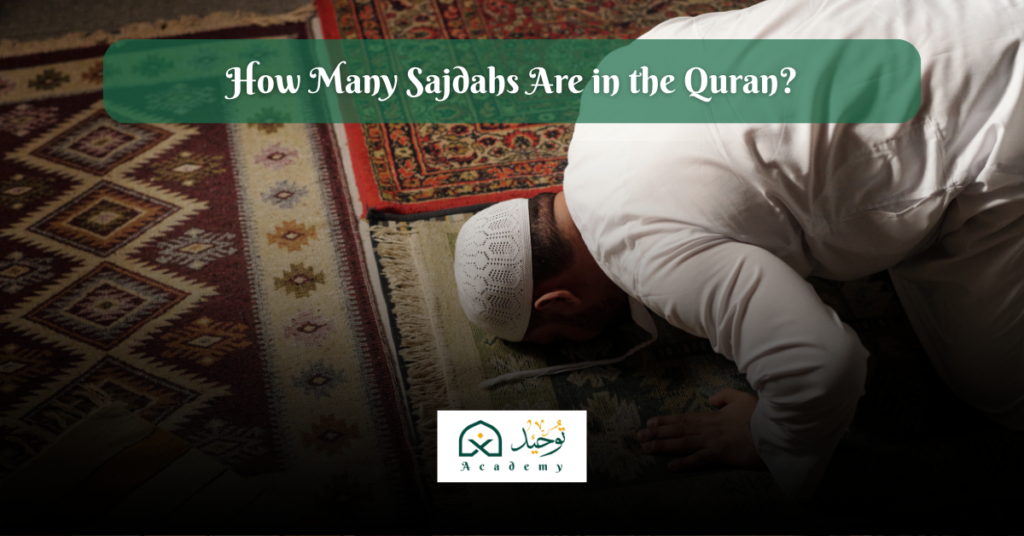
Many Muslims wonder how many Sajdahs there are in the Quran. Is it 14 or 15? A Sajdah means bowing down with your forehead on the ground. It is the moment a believer is closest to Allah and shows complete humility before Him. In this article, we will look at Sajdah-e-Tilawat, the special prostration made when certain verses are recited. We will also find out how many of these verses there are, why scholars give different numbers, and what these verses teach us, so you can understand this act of worship with more clarity.
How Many Sajdahs Are in the Quran: 14 or 15?
Muslims often ask whether the Quran contains 14 or 15 Sajdahs (prostrations). The answer depends on the Islamic school of thought.
Most scholars count 14 Sajdahs in the Quran. However, some scholars, especially those who follow the Hanafi school, count 15 Sajdahs, including the verse in Surah Sad (38:24).
This difference comes from how scholars understand and interpret certain Quranic verses. Both counts are based on Islamic scholarly opinions. Sajdah is an important act of worship that shows our humility and devotion to Allah during Quranic recitation.
What Is Sajda-e-Tilawat?
Sajda-e-Tilawat is a prostration performed when a Muslim recites or hears certain verses of the Quran. These verses are known as verses of prostration. This Sajdah is a way to show obedience, respect, and humility before Allah.
Sajda-e-Tilawat reminds Muslims to follow Allah’s guidance and submit to His commands. The rules for performing it may differ depending on the Islamic school of thought.
Read More: How Many Ayahs in Quran? Quick Guide to Verse Count
What Are the Three Types of Sajdah in Islam?
In Islam, Sajdah means placing the forehead on the ground to show respect and obedience to Allah. There are three commonly discussed types of Sajdah, and each has a different purpose.
- Sajdah Tilawat (Prostration of Recitation): This Sajdah is related to certain verses of the Quran. It is performed when a person recites or hears a verse that calls for prostration.
- Sajdah Shukr (Prostration of Gratitude): Muslims may perform this Sajdah to thank Allah for a blessing, good news, or protection from harm.
- Sajdah Sahw (Prostration for Mistakes in Prayer): This Sajdah is performed to make up for certain mistakes or forgetfulness during Salah. The rules depend on the type of mistake and the Islamic school of thought.
Each type of Sajdah has its own purpose and teaches Muslims to obey Allah, show gratitude, and correct mistakes in prayer.
Which Is the First Sajdah in the Quran?
The first Sajdah-e-Tilawat in the Quran is found in Surah Al-A’raf (7:206). In this verse, Allah describes how the angels worship Him, praise Him, and prostrate before Him.
“Surely those ˹angels˺ nearest to your Lord are not too proud to worship Him. They glorify Him. And to Him they prostrate.”
— Surah Al-A’raf, 7:206
This verse teaches Muslims the importance of worshipping Allah with humility and respect. It also reminds us that even the angels submit to Allah and worship Him without pride.
Dua for Sajdah-e-Tilawat in the Quran
When performing Sajdah-e-Tilawat, Muslims can recite a special dua to praise Allah and show their gratitude. One commonly recited supplication is:
Arabic:
سَجَدَ وَجْهِيَ لِلَّذِي خَلَقَهُ وَشَقَّ سَمْعَهُ وَبَصَرَهُ بِحَوْلِهِ وَقُوَّتِهِ، فَتَبَارَكَ اللَّهُ أَحْسَنُ الْخَالِقِينَ
Meaning in English:
“I have prostrated my face to the One Who created it, and gave it hearing and sight by His might and His power. Glory is to Allah, the Best of creators.”
This dua reminds Muslims of Allah’s power and the blessings He has given them. Reciting it helps express humility, gratitude, and devotion to Allah during Sajdah-e-Tilawat.
Read More: How Many Surahs Are in the Holy Quran?
How to Perform the 14 Sajdahs After Completing the Quran
Some Muslims perform the Sajdahs of Tilawat after completing the Quran as an act of worship and gratitude to Allah. However, these Sajdahs do not have to be performed all at once after finishing the Quran.
To perform them, find the verses of prostration in the Quran and make a Sajdah-e-Tilawat when required. The Quran contains 14 or 15 Sajdahs, depending on the Islamic school of thought. You can follow the guidance of your school regarding how and when to perform them.
These prostrations remind Muslims to obey Allah, thank Him for His guidance, and show respect for His words.
When Is Sajdah-e-Tilawat Obligatory?
Sajdah-e-Tilawat is considered Wajib in the Hanafi school of thought when a person recites or hears a verse of the Quran that calls for prostration. In other Islamic schools, such as the Shafi’i and Maliki schools, it is generally considered a recommended act of worship, although the rulings can differ.
Sajdah-e-Tilawat applies both during Salah and outside prayer. Muslims should perform it promptly when required and follow the guidance of their school of thought.
This Sajdah is a way to show obedience to Allah and respect for His words.
How to Identify Sajdah Verses in the Quran
You can easily find the verses for Sajdah-e-Tilawat in most printed copies of the Quran. These verses are usually marked with a special symbol (۩) near the verse or in the margin. Some copies also include the Arabic word السجدة, which means prostration.
When you see this symbol, it tells you that the verse is a Sajdah verse. If you read the Quran on a mobile app or website, look for the same symbol or a label that identifies the verse.
These markings help readers recognize the verses where Sajdah-e-Tilawat applies.
How to Perform Sajdah-e-Tilawat
Sajdah-e-Tilawat is performed when a Muslim recites or hears a verse of the Quran that calls for prostration. The method can vary slightly between Islamic schools of thought. Here are the basic steps:
- Make Wudu: Make sure you have performed ablution if required according to your school of thought.
- Face the Qiblah: Turn toward the Kaaba in Makkah.
- Say “Allahu Akbar”: Lower yourself into the Sajdah position.
- Recite a Dua: You may recite this supplication while in Sajdah:Arabic:سَجَدَ وَجْهِيَ لِلَّذِي خَلَقَهُ وَشَقَّ سَمْعَهُ وَبَصَرَهُ بِحَوْلِهِ وَقُوَّتِهِ، فَتَبَارَكَ اللَّهُ أَحْسَنُ الْخَالِقِينَ
- Rise from Sajdah: Raise your head and return to a sitting or standing position. A separate Tasleem is generally not required for Sajdah-e-Tilawat performed outside Salah.
Note: The requirements for Wudu, facing the Qiblah, and other details may differ among Islamic schools of thought. Follow the guidance of your school for the correct method.
Start Your Quran Learning Journey with Tawhid Academy
Tawhid Academy offers one-on-one online Quran classes for beginners across the United States. Learn Arabic reading through our Noorani Qaida course, improve your recitation with our Tajweed course, understand Quranic verses through our Tafseer course, or memorize the Quran with our Quran Memorization course. Our qualified teachers guide you step by step at your own pace.
Book your free trial class today and take the first step toward learning the Quran with confidence.
Conclusion
Understanding Sajdah-e-Tilawat helps Muslims follow the teachings of the Quran and show their obedience to Allah. Scholars differ on whether the Quran has 14 or 15 Sajdahs, depending on their school of thought. The important thing is to learn the correct way to perform Sajdah-e-Tilawat and worship Allah with a sincere heart.